

Personal Memories and Context
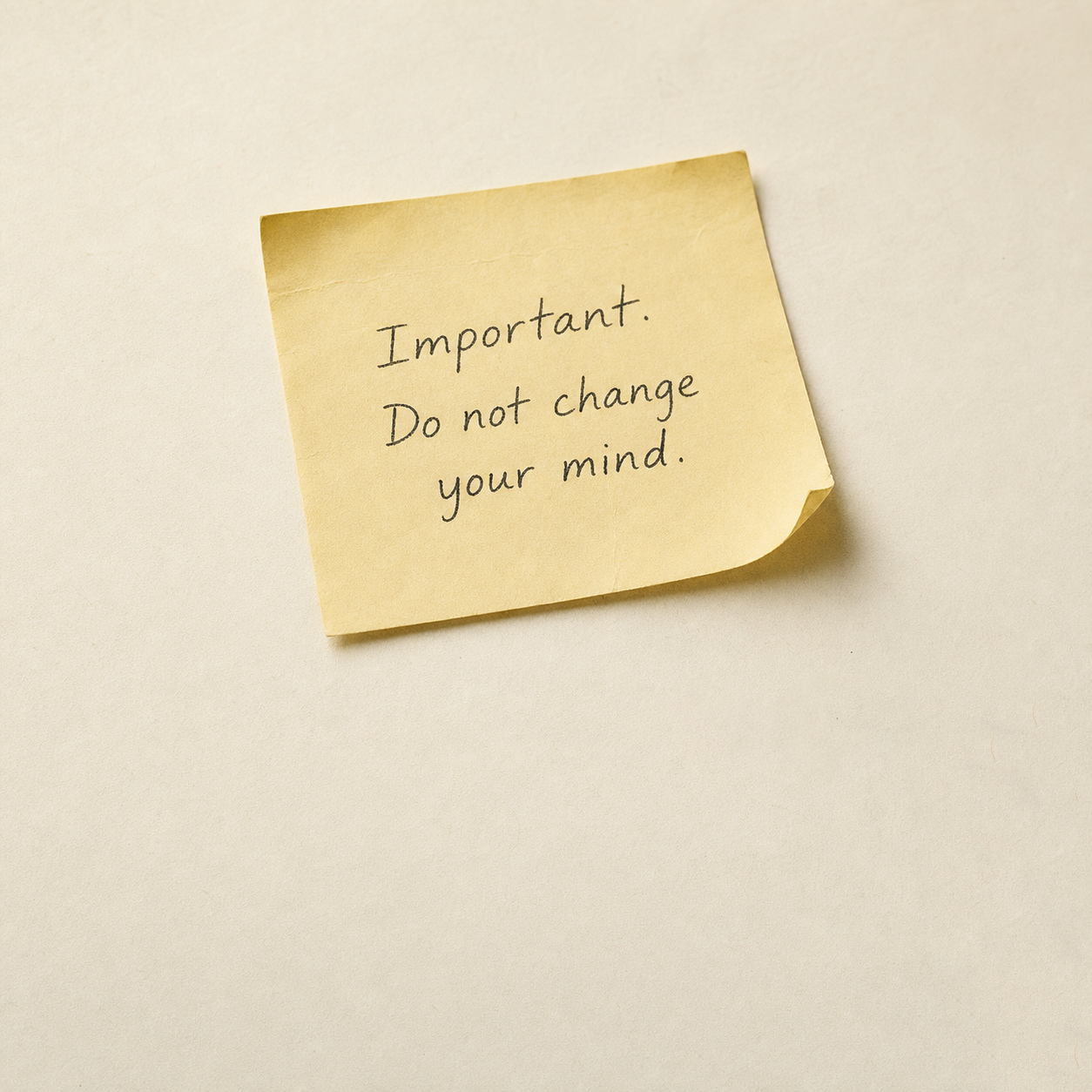
Some notes
are not made
to lose their meaning.
We often think we’re rediscovering an idea. In reality, we’re rediscovering an empty shell if the context is gone. A note, a decision, or a project isn’t sustained by its words alone. It’s sustained by what surrounds it.
A resource page to help you understand why meaning fades away even before the words disappear.
Why Does This Happen?
What Fades Away is not always information.
Sometimes a note is still there, legible and intact. Yet it no longer conveys anything. It no longer recalls the discussion, the tension, the resolution, or the reason it was written.
The problem isn't just that things are forgotten. It's the loss of the context that gave meaning to the information.
For informational purposes only. It remains legible.
Information + context. It remains understandable.
Context lost. Meaning shifts and then fades away.
“Review the file by Friday”
This note may seem perfectly clear at the time. A few weeks later, however, it no longer specifies which matter it refers to, why Friday was important, or what decision needed to be made.
Why Some Notes Become Useless
A short note often asks for too much to his future reader.
We write quickly. We write for ourselves. We write based on what seems obvious at the time. Then, a few weeks later, that obviousness has vanished. The words remain, but the context has evaporated.
A note becomes useless when it contains only a cue. It then lacks what is needed to understand it: the exact subject, the date, the trigger, the intention, or the associated decision.
This is the most common mistake: writing as if the future will remember things the same way the present does.
Why an Idea Disappears
A good idea doesn't hold up only in that sentence.
An idea depends on the problem it solved, the moment it arose, the constraint that gave rise to it, and the doubt it helped dispel. Without these elements, it may seem brilliant one day and useless the next.
It isn't necessarily the idea that has lost its strength. It's the framework that gave it its strength.
“Create a simpler version”
That statement may be correct. But if it doesn't explain what was too complex, for whom, and for what purpose, it becomes difficult to reuse later on.
A common case
A good idea jotted down too quickly
An idea may appear to survive, but it may lose its precision. The result remains, but the original logic does not.
What to Keep
The problem, not just the solution
Keeping the original problem in mind helps you remember why the idea was relevant.
Resuming a Project After a Break
A Project Is Put on Hold faster than it can be told.
When you return to a project later, you can often find the files. But it’s less common to recall the reasons behind the decisions, the roadblocks, the compromises, or the priorities at the time.
The visible part of the project is only part of the actual project. The other part exists within the context: the discussions, the postponed decisions, the ideas that were set aside, and the overall mindset.
That's why resuming a project sometimes feels like starting from scratch, even though you think you're picking up where you left off.
- That was what had been decided.
- What had been ruled out.
- That remained to be confirmed.
- That made the recovery difficult.
What has been chosen is not everything
We often need to keep in mind what has been rejected, set aside, or left unresolved. That is what allows us to revisit the decision without betraying it.
When a Decision Is No Longer Obvious
A decision takes on meaning at a given moment.
A decision seems logical at the time it is made. Later on, it may seem strange if the reasons behind it are no longer apparent.
We don't just document what was chosen. We document why it seemed right at that moment.
You write
A sentence, a thought, a decision, a doubt.
The context is fading
The precise moment, on the other hand, disappears much more quickly.
Meaning is becoming more fragile
The text is still there, but it's harder to read.
The recovery is becoming difficult
You reread it without really figuring out why it mattered.
The Consequences
When the context disappears, Everything costs more.
We waste time reconstructing what we already knew. We second-guess decisions that made sense. We discard ideas that might have been useful. We hold on to fragments, but not to the bigger picture.
The problem isn't a memory deficit. It's a lack of traces capable of sustaining understanding over time.
- A waste of time.
- Frustration upon rereading.
- Repeated decisions.
- Projects abandoned too soon.
- Important ideas lost in the noise.
Can this be avoided?
Yes, if we keep a little more than the result.
It’s not about writing everything down. It’s about writing what the future won’t be able to guess. A good personal record retains enough context to remain useful later on.
The date, the trigger, the reasoning, the alternatives that were ruled out, and the state of mind are often more important than the final sentence itself.
Add the date. Just putting a grade back into the correct time period helps a lot.
Write down the reason. Not just what you decided, but why.
Keep your options open. What you've turned down often sheds light on your final choice.
Note the emotional context. It often explains a good part of what comes next.
FAQ
Frequently Asked Questions.
Why do my notes lose their meaning after a few weeks?
Because they often contain the result of a thought, but not the context needed to understand that thought. The subject, the reason, the urgency, or the state of mind sometimes fade away faster than the words themselves.
How do I find the context of a note?
You need to look at the context surrounding the note: the date, the project in question, the preceding conversation, the decision to be made, the problem encountered, or the goal at the time.
Why do I forget my ideas even though I wrote them down?
An idea jotted down too briefly may remain visible but not usable. For it to endure, you also need to note why it was important, what problem it addressed, and what you intended to do with it.
How do you get back on track with a project after taking a break?
It's easier to pick up where you left off if the project includes a context log: decisions made, reasons, next steps, roadblocks, and unresolved issues.
How can you best preserve your personal reflections?
It is helpful to keep not only the thought itself, but also its origin: what triggered it, what it sought to clarify, and what we hoped to understand later.

Le Carnet
Save which gives it meaning.
The Notebook was designed to capture not only ideas, notes, and decisions, but also the context that helps them remain understandable over time.
A thought written down today can be revisited tomorrow along with its reasons, its context, and its logic. It is precisely this continuity that is most often lacking elsewhere.

